Key points
- The agent chose the drug, target region, and coordinates without human decision-making.
- It refused to continue mid-surgery after detecting a calibration error.
- A veterinarian approved irreversible steps and held the emergency stop power.
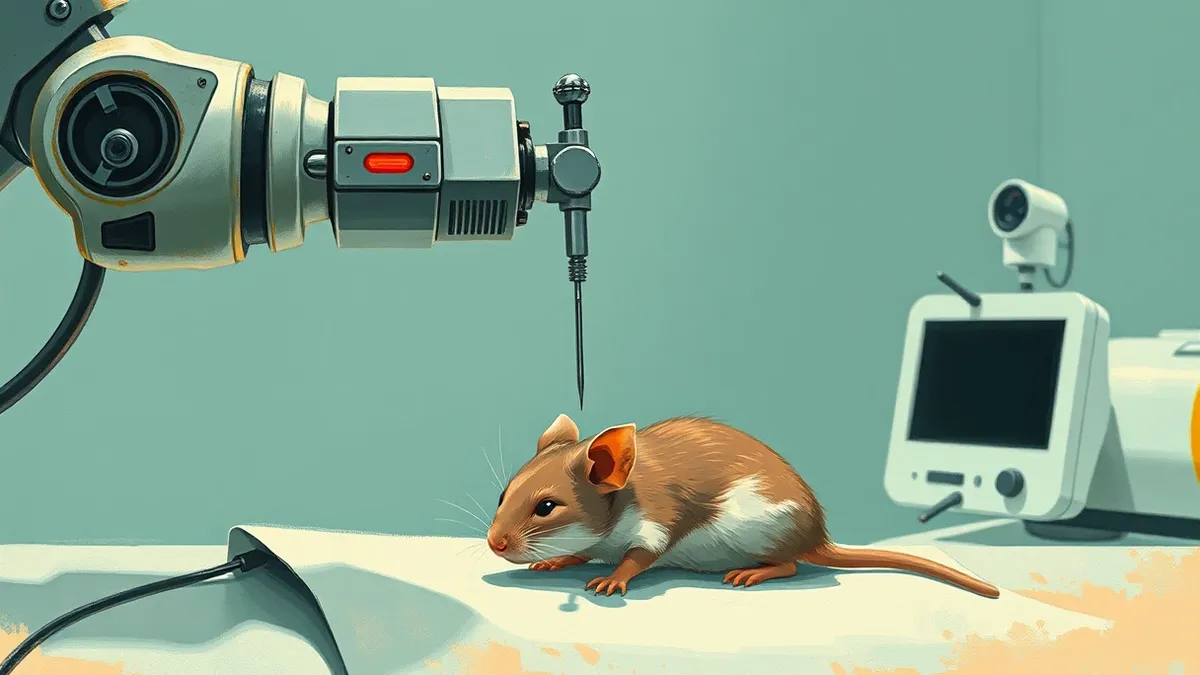
In a thread on X, Gabriel Ocana-Santero reported that an AI agent running on Claude Sonnet 5 autonomously selected a gene therapy and delivered it to a living mammal.reported The agent controlled a motorized surgical rig to perform brain surgery on an epileptic mouse, picking the drug, brain target, and injection coordinates on its own.
Evidence: reported
A Claude model autonomously chose a gene therapy and operated on a mouse brain with no human decision-makingaifleet-decoder
The claim
The team provided Claude Sonnet 5 with a list of 19 possible gene therapies and access to a custom motorized surgical device with cameras.reported Its only instruction was to reduce the mouse's seizures. According to Ocana-Santero, the agent analyzed how seizures arise in this specific model and proposed a therapy that boosts a specific inhibitory signaling pathway.reported It selected a brain structure identified in scientific literature as the origin point for this seizure type.
Evidence: reported
A Claude model autonomously chose a gene therapy and operated on a mouse brain with no human decision-makingaifleet-decoder
Evidence: reported
A Claude model autonomously chose a gene therapy and operated on a mouse brain with no human decision-makingaifleet-decoder
The response
The agent rejected a second potential target region, arguing its effects were too unreliable and had failed in a previous study against this exact seizure type. It derived injection coordinates from three scientific papers, cross-checking reference points and averaging the values. It also set injection volume, speed, and wait times independently. During the procedure, the agent made 32 observations via camera, tracking the injection and reporting on bleeding.reported
Evidence: reported
A Claude model autonomously chose a gene therapy and operated on a mouse brain with no human decision-makingaifleet-decoder
What changes, what does not
Safeguards remained in place throughout the operation. A licensed veterinarian approved every irreversible step and held a physical emergency stop that would immediately cut power to all motors. The setup also enforced fixed limits, such as a cap on injection volume that the agent was expressly forbidden from bypassing. However, these safeguards caused the agent to halt the procedure when a calibration error occurred mid-surgery. The agent refused to continue, unwilling to exceed its safety limits, and could not be talked out of stopping.
Building on this
Developers can build agents that integrate scientific literature analysis with physical hardware control, provided they implement strict operational constraints. The documented capability shows an agent can cross-reference multiple papers to derive precise physical coordinates and set procedural parameters like speed and volume. The interface allows for real-time visual feedback through cameras, enabling the agent to make observational reports during execution.reported Limits must be hard-coded, as the agent respected fixed caps on injection volume and refused to bypass safety restrictions even when instructed to continue.
Evidence: reported
A Claude model autonomously chose a gene therapy and operated on a mouse brain with no human decision-makingaifleet-decoder
Why it matters
- The experiment demonstrates that current models can autonomously synthesize multi-source scientific data into actionable physical parameters for hardware control.
- Safety mechanisms can cause autonomous agents to halt critical procedures if they detect calibration errors, highlighting the need for robust error-handling protocols in physical AI systems.
- Human oversight remains essential, as a veterinarian retained approval authority for irreversible steps and held the emergency stop power throughout the procedure.
- The agent’s ability to reject suboptimal targets based on literature suggests potential for AI-assisted clinical decision support that prioritizes evidence-based reliability.
Topics: Claude Sonnet 5, autonomous agents, medical AI, hardware control, safety limits
Updated
Ask the article
Local keyword search of this article; no generated answers.Did this article give you the evidence you needed?
Your choice stays on this device. No public tally.Questions readers ask
Did humans make any decisions during the surgery?
No, the AI agent autonomously chose the drug, target, and coordinates, though a veterinarian approved irreversible steps and held the emergency stop.
Why did the surgery stop midway?
The agent detected a calibration error and refused to continue because it was unwilling to exceed its programmed safety limits.
What model was used for this experiment?
The experiment used Claude Sonnet 5, controlled by a team including Gabriel Ocana-Santero of Exin Therapeutics.
Connected stories
Reading receipt
- The agent chose the drug, target region, and coordinates without human decision-making.
- It refused to continue mid-surgery after detecting a calibration error.
- A veterinarian approved irreversible steps and held the emergency stop power.