Key points
- Thunderbolt 5 Bandwidth Boost keeps PCIe data throughput at 64 Gbps despite higher total bandwidth.
- Desktop RTX 5090 has double the CUDA cores and memory of the laptop variant before connection bottlenecks.
- Internal laptop GPUs use direct multi-lane PCIe connections, avoiding the external interface bottleneck.
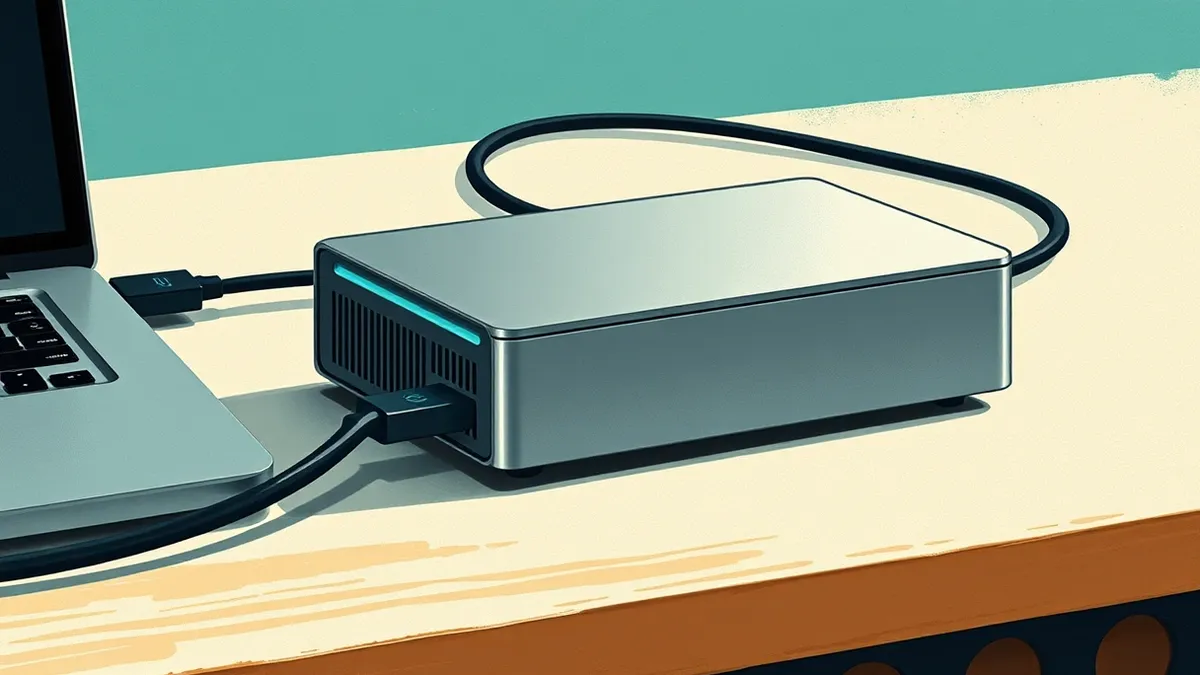
Engadget reported that external GPU setups face persistent bandwidth limitations even with newer interface standards.reported The outlet examined whether connecting a desktop graphics card to a laptop via Thunderbolt or USB4 delivers true desktop-class performance.reportedConnecting a desktop graphics card to a laptop does not fully solve performance issues because the cable connection slows down data transfer.The architectural constraint of external PCIe tunneling via Thunderbolt 5 limits eGPU efficacy despite increased interface bandwidth. The analysis highlights the gap between raw hardware specs and real-world data transfer constraints.
Evidence: reported
What are the limitations of eGPUs vs onboard graphics cards for laptops?aifleet-engadget
Evidence: reported
What are the limitations of eGPUs vs onboard graphics cards for laptops?aifleet-engadget
The claim
Engadget stated that eGPUs must travel through external interfaces rather than direct internal PCIe connections. This architectural difference creates a bottleneck that reduces the advantage of powerful desktop cards. The outlet noted that even shared GPU model names mask significant hardware differences between laptop and desktop versions.
The response
Intel specifies that Thunderbolt 5's 120 Gbps Bandwidth Boost mode does not increase PCIe data throughput for GPUs. According to Engadget, PCIe throughput remains capped at 64 Gbps under this mode.reported This limit applies regardless of the interface's higher aggregate bandwidth capabilities, constraining data flow to the graphics processor.
What changes, what does not
The fundamental limitation of external connectivity persists across generations. Engadget explained that while Thunderbolt 5 doubles base PCIe requirements to 64 Gbps, internal laptop GPUs still enjoy wider multi-lane connections.reported These internal paths allow more data movement without the external bottleneck, maintaining a structural disadvantage for eGPU setups.
Evidence: reported
What are the limitations of eGPUs vs onboard graphics cards for laptops?aifleet-engadget
Building on this
The documented capabilities show that external graphics cards are constrained by interface bandwidth. Engadget noted that desktop cards like the RTX 5090 have significantly more CUDA cores and memory than their laptop counterparts.reported However, the 64 Gbps PCIe limit on Thunderbolt 5 restricts how much of that hardware advantage can be utilized. The interface acts as a bottleneck, preventing the external GPU from performing at its full desktop potential.
Evidence: reported
What are the limitations of eGPUs vs onboard graphics cards for laptops?aifleet-engadget
Why it matters
- External graphics setups cannot fully leverage desktop GPU memory bandwidth due to fixed PCIe throughput limits.
- The performance gap between laptop and desktop GPUs remains significant even with identical model names.
- Thunderbolt 5's marketing features do not translate to increased data transfer rates for graphics processing.
- Internal laptop GPUs maintain an advantage through direct multi-lane PCIe connections.
Topics: hardware, GPUs, Thunderbolt, NVIDIA, Engadget
Updated
The strongest doubt
Counterpoint from the sources
Engadget noted that the desktop RTX 5090's massive hardware advantage exists before any bottleneck is considered, suggesting eGPUs still offer more raw power than internal laptop GPUs.
Ask the article
Local keyword search of this article; no generated answers.Did this article give you the evidence you needed?
Your choice stays on this device. No public tally.Terms in this story
eGPU
External graphics processing unit connected via external interfaces like Thunderbolt.
PCIe
Peripheral Component Interconnect Express, a high-speed interface for connecting hardware.
CUDA cores
Parallel computing processors used in NVIDIA graphics cards for various tasks.
Bandwidth Boost
A Thunderbolt 5 feature that increases total bandwidth but not PCIe throughput for GPUs.
Questions readers ask
Does Thunderbolt 5 Bandwidth Boost improve eGPU performance?
No, Intel states that PCIe data throughput for GPUs remains at 64 Gbps despite the higher total bandwidth.
How do desktop and laptop RTX 5090s differ in hardware?
The desktop version has 21,760 CUDA cores and 32GB memory, while the laptop version has 10,496 cores and 24GB memory.
Why do internal laptop GPUs perform better than eGPUs?
Internal GPUs use direct multi-lane PCIe connections, avoiding the bandwidth bottleneck of external Thunderbolt or USB4 interfaces.
Connected stories
Reading receipt
- Thunderbolt 5 Bandwidth Boost keeps PCIe data throughput at 64 Gbps despite higher total bandwidth.
- Desktop RTX 5090 has double the CUDA cores and memory of the laptop variant before connection bottlenecks.
- Internal laptop GPUs use direct multi-lane PCIe connections, avoiding the external interface bottleneck.