Key points
- Marine biologists face significant challenges in decoding sperm whale vocalizations.
- The sounds resemble heavy wooden doors creaking shut, complicating analysis.
- Artificial intelligence is being used to crack this complex communication system.
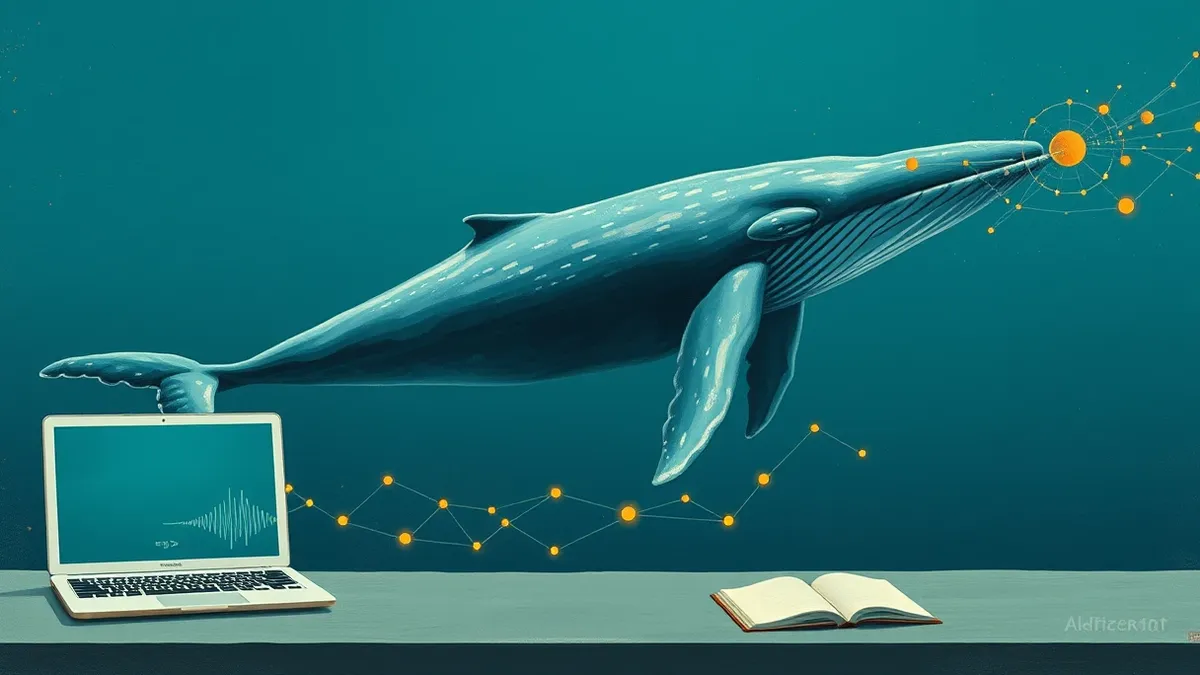
According to a report by Bing News, artificial intelligence is being applied to decode the alphabet of sperm whales.reported This development addresses the difficulty marine biologists face when studying these animals.AI tools are helping scientists understand the sounds made by sperm whales.AI applications are targeting the decoding of sperm whale click patterns. The vocalizations are described as sounding like heavy wooden doors creaking shut. This analogy highlights the complexity of the data.
The claim
The core claim is that AI systems can help decipher sperm whale communication. The source material uses an analogy of decoding an alien language to describe the difficulty. The distinct vocalizations present a unique decoding challenge for researchers. The comparison to creaking doors emphasizes the acoustic nature of the data.
The response
The source material does not provide specific counterpoints or reactions from other researchers. It focuses on the analogy used to describe the difficulty. There is no mention of skepticism or alternative interpretations in the provided text. The narrative remains centered on the decoding effort.
What changes, what does not
The use of AI changes the approach to analyzing whale sounds. However, the fundamental difficulty of the task remains. The source does not state that the alphabet is fully solved. It implies an ongoing effort to understand these vocalizations. The exact scope of the decoding is not detailed.
Building on this
Developers can build audio analysis tools focused on low-frequency, repetitive sounds. The interface would need to handle complex acoustic patterns. Limits include the inherent difficulty of decoding these specific vocalizations. The material suggests AI can assist in pattern recognition. Applications could include marine research data processing.
Why it matters
- AI applications in marine biology require robust audio processing capabilities.
- Decoding animal communication presents unique data challenges for developers.
- The analogy of creaking doors highlights specific acoustic characteristics.
- This research area may drive new tools for bioacoustic analysis.
Topics: AI, marine biology, audio analysis, research
Updated
The strongest doubt
Counterpoint from the sources
The source material does not provide any opposing points or doubts.
For readers
Researchers
- AI can assist in decoding complex animal sounds
- The task is likened to cracking an alien language
Developers
- Audio analysis tools must handle repetitive acoustic patterns
- Interfaces should support pattern recognition for bioacoustics
Policy
- Marine research may benefit from AI-driven data analysis
- No specific policy implications are stated in the source
Ask the article
Local keyword search of this article; no generated answers.Did this article give you the evidence you needed?
Your choice stays on this device. No public tally.Terms in this story
Sperm whales
Marine mammals with distinct vocalizations
Vocalizations
Sounds produced by animals for communication
Artificial intelligence
Technology used for complex data analysis
Marine biologists
Scientists who study ocean life
Questions readers ask
What do sperm whale vocalizations sound like?
They are described as sounding like heavy wooden doors creaking shut.
How is AI being used in this context?
AI is being used to attempt to decode the sperm whale alphabet.
Who is facing these decoding challenges?
Marine biologists face these challenges when studying sperm whales.
Connected stories
Reading receipt
- Marine biologists face significant challenges in decoding sperm whale vocalizations.
- The sounds resemble heavy wooden doors creaking shut, complicating analysis.
- Artificial intelligence is being used to crack this complex communication system.
Still open: Has the sperm whale alphabet been fully decoded?
Still open: What specific AI models are being used for this task?